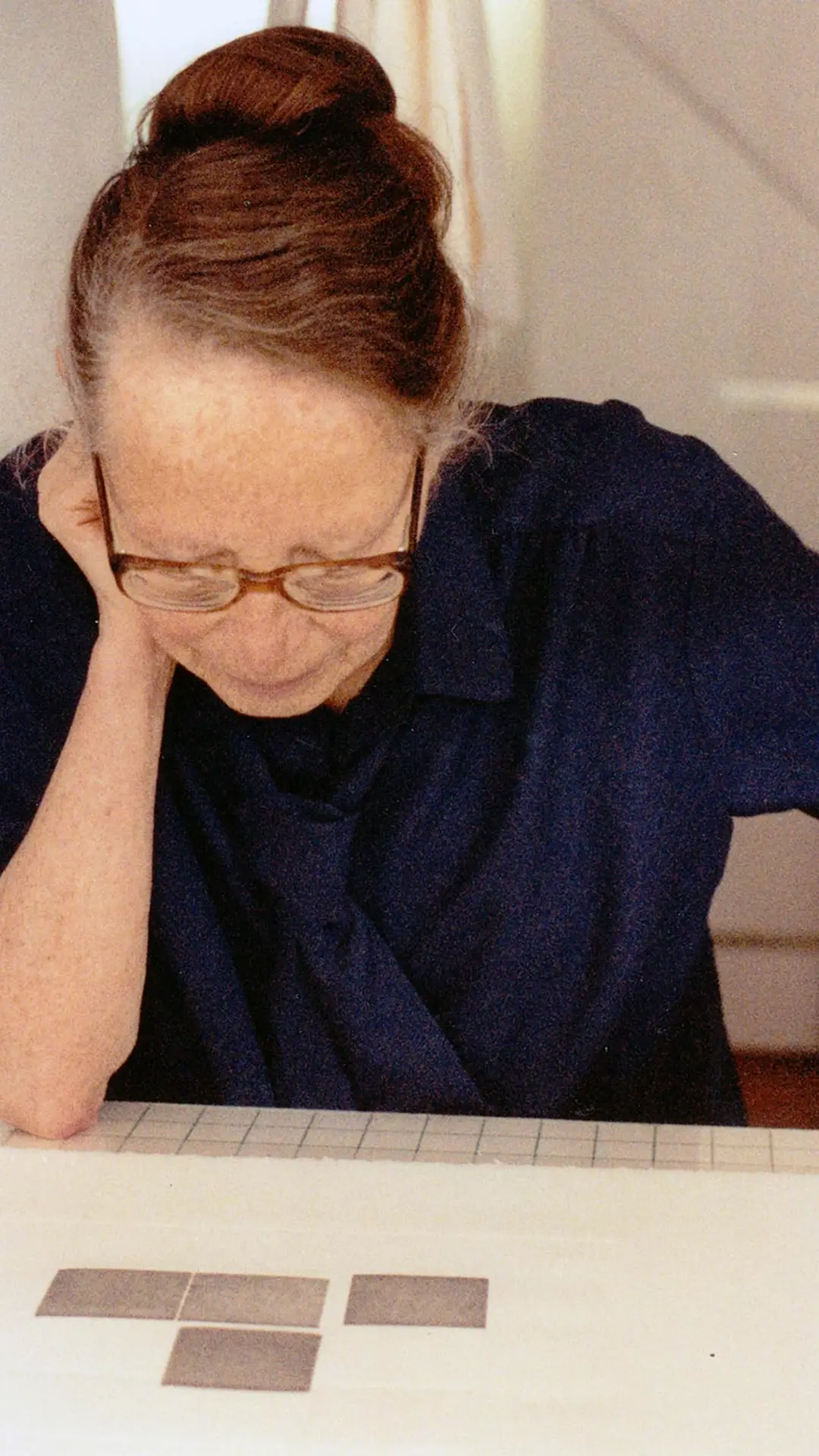
Vera MolnarBorn in Hungary in 1924, Vera Molnar is one of the first artists to use computers in her practice.Wurde 1924 in Ungarn geboren und ist eine der ersten Künstlerinnen überhaupt, die mit Computern Kunst generierte.Nata in Ungheria nel 1924, Vera Molnar fu una delle prime artiste a utilizzare il computer nella sua pratica.Née en Hongrie en 1924, Vera Molnar fut l’une des premières artistes à intégrer l’ordinateur dans sa pratique.Trained as a traditional artist, she studied art history and aesthetics at the Budapest College of Fine Arts and moved to Paris in 1947. She co-founded several pioneering artist research groups such as G.R.A.V. (Groupe de Recherche d'Art Visuel), which investigate collaborative approaches to mechanical and kinetic art, and the research group for art and computer science at the Institute of Art and Science in Paris.
Pre-dating the computer, she invented algorithms or “machine imaginaire” that allowed the creation of image series following a set of pre-ordained compositional rules. Beginning in 1968, the computer became a central device in the making of her paintings and drawings, allowing her to more comprehensively investigate endless variations in geometric shape and line.
She is the recipient of countless awards, her works are exhibited from the MoMA in New York to the Centre Pompidou in Paris.
She would often mention, that her artworks contain 99% order and 1% disorder. Vera Molnar passed away in Paris on December 7, 2023 – only a few days before turning 100.Vera Molnar studierte Kunstgeschichte und Ästhetik an der Budapester Kunsthochschule und zog 1947 nach Paris.
Sie war Mitbegründerin mehrerer bahnbrechender Künstlergruppen, wie der G.R.A.V. (Groupe de Recherched’Art Visuel), die kollaborative Ansätze für mechanische und kinetische Kunst untersucht, sowie der Forschungsgruppe für Kunst und Informatik am Institut für Kunst und Wissenschaft in Paris. Noch vor dem Zeitalter des Computers entwarf die Künstlerin eine Technik, welche sie «Machine Imaginaire» nannte, um Algorithmen zu erschaffen. Diese ermöglicht die Erstellung von Bildserien von Hand nach vorgegebenen Kompositionsregeln. Ab 1968 wurde der Computer zum wichtigsten Werkzeug bei der Erstellung ihrer künstlerischen Arbeiten. Der Computer ermöglicht ihr, die endlosen Variationen von geometrischen Formen und Linien ausführlicher zu untersuchen.
Sie ist Trägerin unzähliger Auszeichnungen, und ihre Werke werden vom MoMA in New York bis zum Centre Pompidou in Paris ausgestellt.
Vera Molnar pflegte zu sagen, ihre Kunst sei zu 99% Ordnung und zu 1% Unordnung. 2023 verstarb sie in Paris, wenige Tage vor ihrem hundertsten Geburtstag.Formatasi tradizionalmente, studiò storia dell’arte ed estetica all’Accademia di Belle Arti di Budapest prima di trasferirsi a Parigi nel 1947.
Fu cofondatrice di diversi gruppi di ricerca artistica pionieristici, tra cui il G.R.A.V. (Groupe de Recherche d’Art Visuel), che esplorava approcci collaborativi nell’arte meccanica e cinetica, e il Gruppo di Ricerca per l’Arte e l’Informatica presso l’Istituto d’Arte e Scienza di Parigi.
Ancor prima dell’avvento del computer, ideò algoritmi o una «macchina immaginaria», che le permetteva di creare serie di immagini a mano seguendo regole compositive predeterminate. A partire dal 1968, il computer divenne uno strumento centrale nella realizzazione dei suoi dipinti e disegni, consentendole di esplorare in modo più approfondito le infinite variazioni di linee e forme geometriche.
È vincitrice di innumerevoli premi, e le sue opere sono esposte dal MoMA di New York al Centre Pompidou di Parigi.
Vera Molnar amava ricordare che le sue opere erano «al 99% ordine e all’1% disordine». Morì a Parigi nel 2024, poco prima del suo 100ᵂ compleanno.Formée traditionnellement, elle étudia l’histoire de l’art et l’esthétique à l’École des Beaux-Arts de Budapest avant de s’installer à Paris en 1947.
Elle cofonda plusieurs groupes de recherche artistique pionniers, dont le G.R.A.V. (Groupe de Recherche d’Art Visuel), qui explorait des approches collaboratives de l’art mécanique et cinétique, ainsi que le Groupe de Recherche pour l’Art et l’Informatique à l’Institut d’Art et de Science de Paris.
Avant même l’ère de l’ordinateur, elle inventa des algorithmes ou une «machine imaginaire», lui permettant de créer des séries d’images à la main suivant des règles de composition prédéfinies. Dès 1968, l’ordinateur devint un outil central dans la réalisation de ses peintures et dessins, lui offrant la possibilité d’explorer plus systématiquement les variations infinies des lignes et des formes géométriques.
Elle est lauréate d’innombrables prix, et ses œuvres sont exposées du MoMA à New York au Centre Pompidou à Paris.